Are Minecraft Hacked Clients Safe? What Four Years in the Scene Taught Us
Most hacked client risks aren't the cheat. Free clients, cracks, files from friends and projects that vanish, plus how to check a client before you run it.
We’ve been building Minecraft software since 2022. In that time we’ve watched dozens of clients launch, blow up and vanish, and we’ve heard more stories than we can count from players who trusted the wrong download. A lot of those players ended up in our Discord, and more than once we’ve helped them and the people around them recover their accounts and limit the damage someone else caused.
So when someone asks whether hacked clients and ghost clients are safe, our honest answer is: it depends on who made yours, how long they’ve been around, and where you got it. The cheat itself is rarely the biggest risk. The people and the files around it are.
Short answer: Many Minecraft hacked clients are not safe. The biggest risks are free clients from developers nobody knows, cracked copies of paid clients, files passed around by “friends”, and new projects that disappear after taking your money.
Free clients: somebody is always paying
We’ll be upfront about this one, because we’ve lived it. Akira started out free. As more people joined and the project grew, the cost of keeping it running grew with it: servers, updates for every anti-cheat change, support for more and more users. At some point the time and money it takes stop being a hobby, and we moved to paid so we could keep doing it properly. Today Akira JNI and Akira Memory are paid, and Akira Clicker is still free.
Every free client reaches that same point eventually. When it does, the developer has a choice. Some start charging. Some quietly give up. And some realise that the thousands of people who already installed their software, trust it, and accept every update without thinking are worth a lot of money.
That’s the version that scares us. A client doesn’t have to start as malware. It can be clean for months, build a loyal user base, and then one update later it’s a token logger sending your Minecraft account, your Discord and your saved browser passwords to someone else. No new download, no warning, just an update you clicked through like every other one.
We want to be really clear here: this isn’t a hypothetical. It has happened in this community more than once, to clients people genuinely trusted, and it will happen again.
Is a client safe if everyone uses it?
This is the one we hear the most. “My friend has been using it for months.” “A big YouTuber uses it.” “I ran it and nothing happened.”
Malware doesn’t work like that anymore. It doesn’t wipe your PC, throw up a skull on your screen or make your computer slow down. Modern malware is built so you never notice it. It runs quietly in the background, takes your session tokens and passwords, and stays out of the way. The fact that nothing happened is exactly what it’s designed to look like.
The other one we hear a lot is “it’s open source, so it’s safe.” It isn’t, automatically. There have been multiple cases of clients that contained malware even though their source code was public. Hiding a few lines that download a payload later, or tucking malicious logic somewhere nobody looks, isn’t hard. And let’s be honest: almost nobody actually reads the code. Open source only protects you if someone qualified has looked, and the build you downloaded actually matches what they looked at.
Don’t trust your “friends”
This is how a lot of people get hit, and it’s the one that hurts the most.
You meet someone in a game, you play together for a few weeks, you become friends. Then one day they send you a mod or a client. It’s great, they say, totally safe, and to prove it they’ll run it on their own PC while you watch. A huge number of targeted attacks start exactly like this. Building trust first is the whole point.
Think about it this way: would you leave the door to your house wide open when you go out, just because someone on the street told you it’s safe? Running a file because someone you met online swears it’s fine is exactly that.
Sometimes your friend isn’t the bad guy, either. They got the file from somewhere, they believe it’s fine, and they’re passing it on with the best intentions. Either way, the result for you is the same.
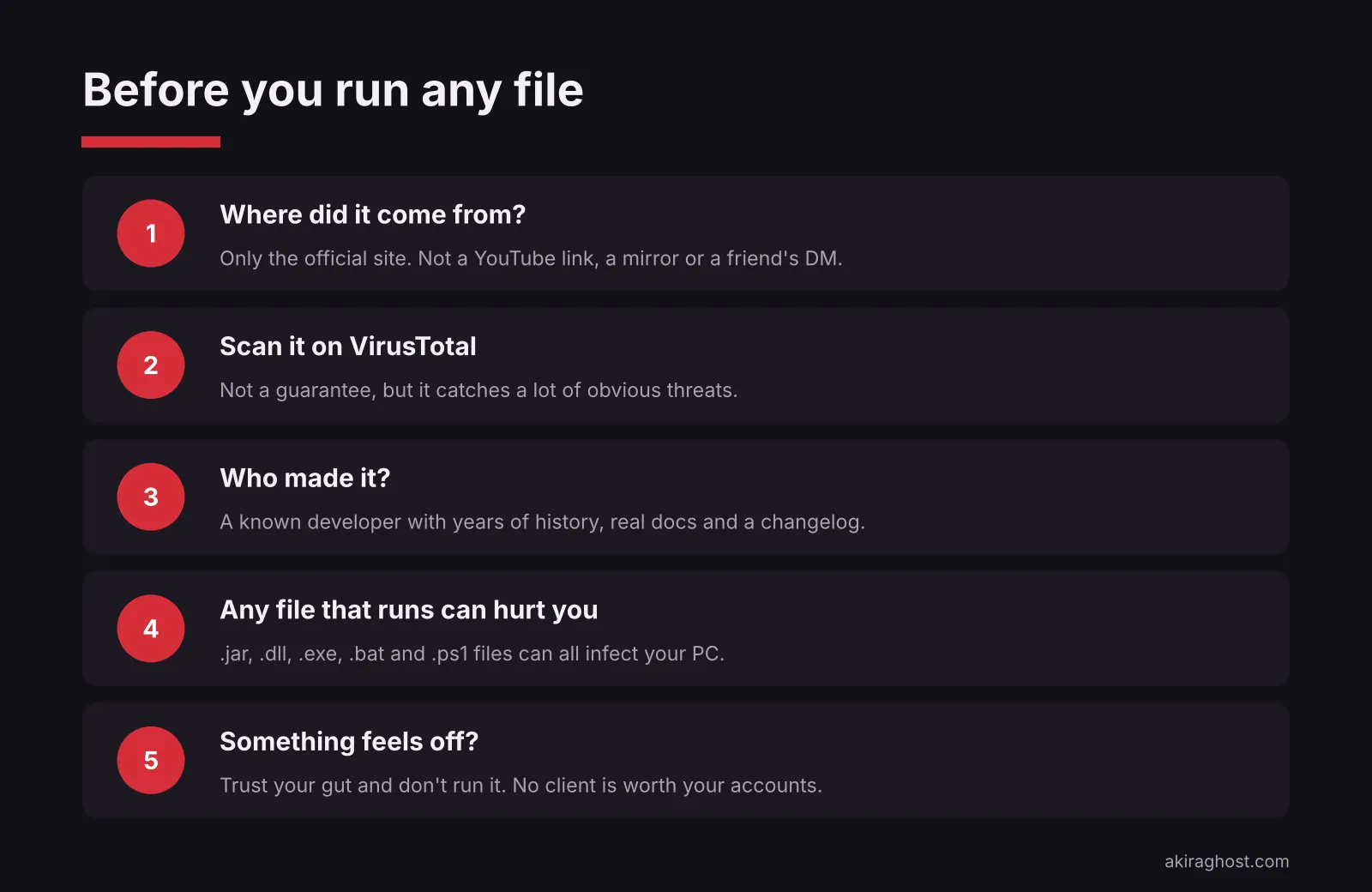
So always ask where they got it from, and only download from the official site of the project. If they can’t tell you, that’s your answer.
Before you run anything, upload it to VirusTotal. It’s not 100% accurate, and a clean result doesn’t guarantee a clean file, but it gives you a decent idea of whether something is obviously harmful. We recommend it to everyone.
Can a .jar file have a virus?
Yes. Please drop the idea that some file types are safe. We hear “it’s just a .jar” or “it’s only a DLL” all the time. Jar files, DLLs, executables, even a batch file or a PowerShell script can carry a virus and infect your PC. If it can run, it can hurt you.
“Free Vape” and other cracks
Search for a Vape crack or a Tenacity crack and you’ll find no shortage of them. YouTube videos with a link in the description, crack sites, GitHub repos with a single loader in them. The source code of plenty of well-known paid clients has been floating around for years, which makes repackaging them easy.
You have no idea who made that file or what they added to it. The real developers didn’t make it. Someone else took their client, did something to it, and is giving it away for free. Ask yourself why. If you’re wondering whether Vape client is safe, remember that the real client and a cracked copy are not the same file, and only one of them comes from the people who built it. Free copies of popular paid clients are one of the most common ways people get their accounts stolen, precisely because so many players want them.
New names, gone by next season
Clients come and go fast in this scene. A new one shows up with a slick website, a big Discord and a launch sale on lifetime keys. A few months later the updates slow down, the Discord goes quiet, and the anti-cheat catches up. Lifetime turns out to mean the lifetime of the project.
It doesn’t only happen to unknown names, either. We’ve watched developers with real reputations start new projects, everyone jumps on because of who’s behind it, and then it slowly fades out. Sometimes it’s burnout, sometimes it was always a side project, sometimes the hype was just bigger than the work behind it.
We’ve called some of these out before. Clients that were clearly hyping themselves up to make as much money as possible, as fast as possible, and then dip. We were right more often than we’d like.
A brand-new client with no history, no known developer and an aggressive lifetime deal is a red flag. Not proof of a scam, but a good reason to wait and watch before you pay.
AI-built clients: the newest problem
The latest wave is clients built mostly with AI by people who have never really developed software before. AI can produce code that runs. What it can’t give you is a developer who understands that code.
You see it the moment something breaks. The anti-cheat updates, the client starts getting flagged, and the person behind it can’t fix what they never understood in the first place. Support turns into “reinstall it” and “wait for the next update”, because there’s nobody on the other end who knows how the software actually works. This has become one of the biggest problems in the Minecraft cheating community, and it’s getting worse.
And there’s a bigger issue than broken features. Writing software is one thing. Once people install it, you’re responsible for keeping them and their data safe. AI will happily write code that works and is wide open at the same time, and if the developer can’t read it, they’ll never know. You’re trusting that person with your accounts and with software that runs on your PC.
Sooner or later, every one of these projects hits an invisible wall. Some problem comes up that AI can’t solve, because solving it takes someone who actually understands how the client works, how the game works and how the anti-cheat works. A real developer can dig in and find the answer. Someone who has only ever prompted their way through can’t, so they’re stuck, and in most cases the project just dies there.
And that wall isn’t always in the client itself. Often it’s everything around it: the backend, the servers, the licensing and authentication system, the database holding user accounts. A client can look fine on the surface while the infrastructure behind it is held together with tape. That’s usually where things break first when a project suddenly gets popular, and it’s also where your data actually lives.
It also helps to remember who’s usually behind these clients. Most of them are cheaters first. They don’t really care about the product; they wanted something to cheat with, and selling it was a bonus. The moment they stop playing Minecraft, find a client they like more, or simply get bored of working on it, the client dies with their interest, and everyone who paid is left with nothing.
How to check a client before you trust it
None of this means every client is dangerous. It means you should ask a few questions before you run anything:
- How long has it been around? Years of history beat a launch-week hype cycle.
- Who builds it? A known, reachable developer is accountable. An anonymous brand isn’t.
- Is there a real changelog and real documentation? People who understand their software can explain it.
- Where are you downloading it from? Only the official site. Not a YouTube description, not a mirror, not a “free” reseller, not a friend’s DM.
- How do they treat people? Watch how the developer and staff talk to their community. Are they patient and good at communicating, or toxic and unpleasant to deal with? If they don’t respect their own users, why would they respect you or your data?
- How do they act when things break? Look at their Discord during the next anti-cheat update. That tells you more than any feature list.
And if something feels off, trust your gut. You don’t need proof. It’s not worth risking your accounts, your bank cards and whatever else is on your PC for a client.
Think you’ve been compromised?
If you think you’ve run something you shouldn’t have, or you can’t decide whether a file is safe, reach out to us on our Discord. We can’t promise to fix everything, but we’ve helped plenty of people through this before, and we might be able to give you some tips and point you in the right direction.
Four years in, the clients worth trusting aren’t the ones with the loudest launch. They’re the ones still here, still updating and still treating their community well long after the hype is gone.
Glossary 13 terms
- Hacked client
- A modified Minecraft client with cheat features built in, like reach, autoclicking or ESP.
- Ghost client
- A cheat client built to look like normal play, giving small, subtle advantages instead of obvious hacks.
- Malware
- Any software built to harm you or steal from you, like stealers, trojans and keyloggers.
- Token logger
- Malware that steals the login tokens apps keep on your PC, so attackers can use your Minecraft or Discord account without your password.
- Minecraft session
- The login token your launcher stores so you stay signed in. Whoever has it can play on your account.
- Open source
- Software whose source code is public, so anyone can read it. Public doesn't mean someone has actually checked it.
- Source code
- The human-readable code a program is built from. Once it leaks, anyone can rebuild and repackage the software.
- DLL
- A Windows library file that other programs load. Anything that loads it runs its code.
- JAR file
- The file format Java programs, including Minecraft mods and clients, are packaged in. It can run code like any other program.
- Crack
- A modified copy of paid software with its license check removed, shared by someone other than the original developer.
- Lifetime key
- A one-time purchase that promises access for as long as the client exists.
- Anti-cheat
- A server plugin or service that watches player behaviour and flags anything that looks like cheating. Intave, Polar and FairPlay are examples.
- Flag
- When an anti-cheat marks something as suspicious. A flag is a note for review, not a ban.