What Is a Ghost Client in Minecraft? Ghost vs Blatant vs Hybrid Explained
Ghost, blatant and hybrid Minecraft clients explained by the people who build them. What each one does, who it's for, and whether you can get banned.
Ghost, blatant, hybrid. If you’ve spent any time around Minecraft PvP, you’ve seen these words thrown around, usually by people who use them slightly differently. We’ve been building ghost clients since 2022, and we still get asked what the difference actually is all the time. All three are types of hacked client, but they’re built for very different players.
So here’s how we see it, from the side of the people who build them.
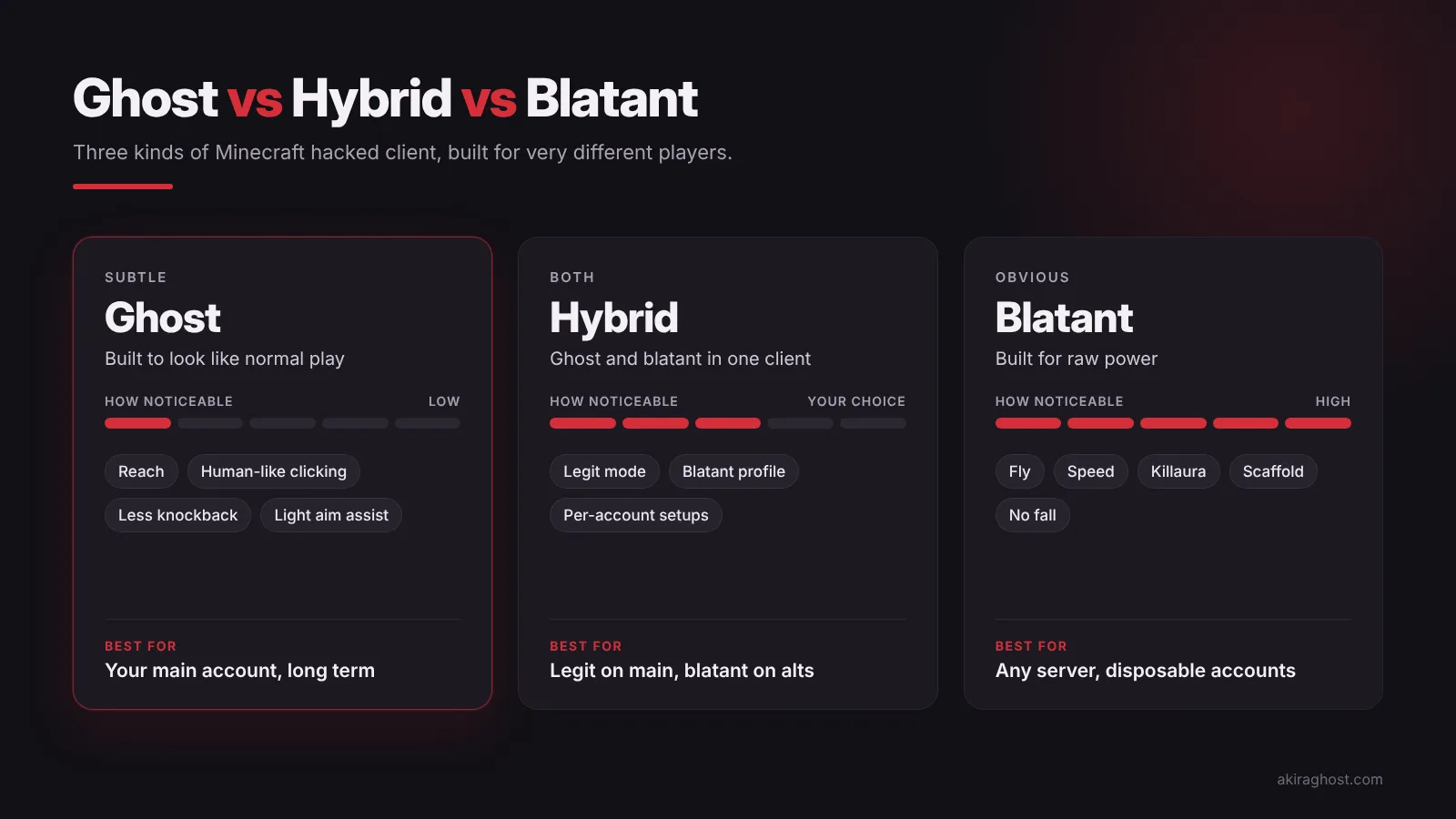
Short answer: A ghost client gives you small, hidden advantages and is built to look like normal play. A blatant client gives you obvious, game-breaking cheats like flying or killaura. A hybrid client tries to do both in one package, with separate modes for each.
What is a ghost client?
A ghost client is built around one idea: nobody should be able to tell. Not the anti-cheat, not the player you just beat, not the staff member watching your fight.
Instead of breaking the game, a ghost client nudges it. A little extra reach. An autoclicker that clicks like a human. Slightly less knockback. A gentle aim assist that helps you track without snapping. Each of these on its own is small. Together, they make a good player play like a great one. Breeze and Slinky are two of the best-known names in this category.
Most ghost clients are built around the same handful of features. Reach adds a fraction of a block to how far you can hit. An autoclicker keeps your clicks fast and consistent, ideally with timing that looks human. Velocity reduces how much knockback you take, so you stay in the fight. Aim assist gently helps your crosshair follow a target. None of it is dramatic on its own, and that’s exactly the point.
That’s the important part: you still have to play. A ghost client doesn’t win the fight for you. If you can’t aim, move or read your opponent, a few extra decimals of reach won’t save you. The people who get the most out of ghost clients are usually already decent at PvP and want an edge that doesn’t put a target on their back.
Because the goal is to blend in, the hard work in a ghost client isn’t the features. It’s everything around them. How the client runs alongside your normal launcher, whether it shows up when you stream or record, how believable the timing is, how it holds up when the anti-cheat updates. That’s where good ghost clients and bad ones really separate.
What is a blatant client?
A blatant client does the opposite. It doesn’t care who sees.
Fly, speed, killaura hitting everything around you, scaffold building bridges under your feet, no fall damage. It’s the kind of cheating anyone can spot from across the map, and that’s kind of the point. Blatant clients are about raw power and spectacle, not subtlety. Rise is one of the best-known examples.
Blatant players play everywhere: big networks, minigame servers, anarchy servers, HvH. The difference isn’t where they play, it’s that they simply don’t care about getting banned. When an account goes, they make a new one and carry on. Some of the most creative engineering in the scene has gone into blatant modules, and the people who build them often know the game’s movement and combat code inside out.
What blatant clients aren’t built for is keeping an account alive. Turn on fly on a major network and that account usually doesn’t last the game. Blatant clients spend their effort on getting past the anti-cheat for as long as possible, not on looking like a real player, so they suit people who treat accounts as disposable.
What is a hybrid client?
A hybrid client tries to be both. It ships with ghost-style modules and blatant ones, usually with some kind of “legit mode” or separate profiles to switch between them. Vape is the best-known name here, with both a ghost side and a blatant side.
The typical hybrid player still cheats on the big networks, but splits it by account. On their main account they play it safe with the ghost side and keep everything believable. On alts or on servers they don’t care about, they switch to the blatant modules and stop holding back. One client covers both, and for some players that’s genuinely the appeal.
The catch is that ghost and blatant clients are built with very different priorities. A ghost client is designed from the ground up to stay invisible. A blatant client is designed to do as much as possible. When one piece of software tries to do both, it usually ends up optimised for neither. The ghost side is often an afterthought, a set of toned-down blatant modules rather than something built to blend in.
There’s also the human factor. With a hybrid, you’re one wrong keybind or one forgotten profile away from turning on something blatant in the middle of a ranked game. It’s an easier mistake to make than most people think.
Is Lunar Client a ghost client?
No. Lunar Client, Feather and Badlion are legit PvP clients. They give you better FPS, HUD mods, cosmetics and quality-of-life features, and they’re allowed on most big servers. There are no cheats in them.
People mix them up because ghost clients are often used alongside them. A ghost client is something that runs on top of the client you already play on, which is why so many players use one with Lunar or Feather open. Ours, Akira JNI and Akira Memory, work with Lunar, Feather, Forge and vanilla for exactly that reason. But the PvP client itself is just a PvP client, and downloaded from its official site, it’s one of the most widely used pieces of Minecraft software out there.
Ghost clients on 1.8.9 vs newer versions
Where you play changes what a ghost client needs to do.
On 1.8.9, there’s no attack cooldown. Fights are decided by how fast and how consistently you can click, how well you manage your combos and how much knockback you take. That’s why autoclickers and velocity matter so much in 1.8 PvP, and why the timing of every click is under so much scrutiny from anti-cheats.
From 1.9 onwards, the attack cooldown changes everything. Spamming clicks stops being useful, and each hit has to be timed. The advantages that matter shift toward reach, aim, movement and hitting at exactly the right moment. A ghost client built for 1.8.9 doesn’t automatically translate to modern versions, and the good ones are tuned for the version you actually play.
Are ghost clients undetectable?
No client is undetectable forever, and anyone who promises you that is selling something. Anti-cheats keep getting smarter, and every serious ghost client is in a constant back and forth with them.
What a well-built ghost client gives you is a much lower profile. Its modules are designed to stay inside what a real player could plausibly do, its timing is built to look human, and it gets updated when detection changes. How you use it matters just as much. Maxed-out settings on a ghost client can look as suspicious as a blatant one, and the players who last longest are the ones who keep their settings believable.
Can you get banned for using a ghost client?
Yes. Using any cheat client is against the rules on almost every big server, and a ghost client is no exception. Lower risk doesn’t mean no risk.
Bans don’t always come straight away, either. Many servers collect evidence quietly and ban in waves, so an account can feel safe for weeks and still get caught up later. How likely that is depends on the server, the anti-cheat, how aggressive your settings are and how you play. The players who get banned on ghost clients are usually the ones who got greedy with their settings or stopped playing like themselves.
Which one is right for you?
It mostly comes down to two questions: where do you play, and what do you actually want out of it?
If you don’t care about your accounts and just want maximum power wherever you play, a blatant client is the honest choice. There’s no point paying for subtlety you’ll never use.
If you play on big moderated networks, care about your account, and want to keep playing the game rather than watching it play itself, you want a ghost client. That’s the only category actually built to keep you under the radar long term.
If you want to play it safe on your main account and go all out on alts, a hybrid can work, as long as you go in knowing the ghost side probably isn’t its main focus, and you’re careful about which profile is on which account.
Whichever you choose, the same rules from our guide to hacked client safety apply. Who builds it, how long they’ve been around and where you download it from matter far more than the feature list.
Why we only build ghost clients
We made this choice early on, and it’s the whole idea behind every Minecraft ghost client we build: enhance, don’t overwrite.
We think the best version of this software is the one you barely notice. It sharpens what you already do instead of replacing you with a bot. You still make the plays, you still win the trades, and the edge is something you feel rather than something everyone can see. That’s also why so much of our work goes into the parts nobody sees, like how the autoclicker timing holds up against modern anti-cheats.
It’s not the flashiest corner of the scene, and that’s fine by us. Four years in, we’d rather build something that quietly works for a long time than something loud that burns out.
Glossary 15 terms
- Ghost client
- A cheat client built to look like normal play, giving small, subtle advantages instead of obvious hacks.
- Hacked client
- A modified Minecraft client with cheat features built in, like reach, autoclicking or ESP.
- Anti-cheat
- A server plugin or service that watches player behaviour and flags anything that looks like cheating. Intave, Polar and FairPlay are examples.
- Reach
- How far away you can hit another player. Vanilla reach is 3 blocks, and ghost clients add a small amount on top.
- Autoclicker
- Software that clicks for you, either at a fixed speed or with randomized timing.
- Velocity
- A module that reduces how much knockback you take when you're hit.
- Knockback
- How far you get pushed back when you're hit. Reducing it is often called velocity.
- Killaura
- A blatant module that automatically attacks every player around you, wherever you're looking.
- Scaffold
- A blatant module that places blocks under your feet automatically as you walk, so you can bridge without looking down.
- Anarchy server
- A Minecraft server with no rules and no anti-cheat bans, where cheating is allowed. 2b2t is the most famous one.
- HvH
- Short for hacker versus hacker: fights where both sides are openly using cheats.
- Module
- A single feature inside a cheat client, like an autoclicker or reach, that you can switch on and off.
- Legit mode
- A profile in a hybrid client that turns off the blatant modules and tones the rest down to look like normal play.
- PvP client
- A legit Minecraft client like Lunar, Feather or Badlion, with better performance, HUD mods and cosmetics but no cheats.
- Ban wave
- When a server bans many cheaters at once after quietly collecting evidence, often weeks after the cheating happened.